





You pay for analysis because it reduces expensive uncertainty before delivery starts.
In digital projects, the cost of being wrong is rarely the invoice for analysis. The cost is rework, delays, scope fights, bad adoption, and compliance fixes discovered too late.
So, would you really skip the digital dransformation analysis?

Hot takes about digital transformation analysis
- Analysis is not “talk before work.” It is the work. It turns a vague mix of ideas into a decision-quality plan with scope, risks, priorities, and trade-offs.
- Skipping analysis does not save money. It often shifts costs to delivery, where mistakes are slower and more expensive to fix (and politically harder to admit).
- “Figure it out later” is a lot riskier. Firms are investing in skills shortages, regulatory pressure, and uncertainty; you should too (probably).
- Good analysis buys executive control. It gives leadership a basis to decide what to do now, what to defer, and what not to fund yet.
Why is analysis charged instead of bundled into delivery?

Because analysis creates value even before a single solution is built.
That value is a decision asset. It helps you decide whether to proceed, what to prioritize, what to sequence, and what risks to own.
A lot of leaders understandably expect vendors to “just include analysis.” The problem is simple, at least in modern psychology:
If analysis is treated as free, it is often rushed, hidden, or biased.
From our experience, that is where expensive surprises happen.
We found another useful reality check. McKinsey and Oxford’s analysis of more than 5,400 IT projects found that large IT projects ran 45% over budget on average and delivered 56% less value than predicted.
This is exactly why treating analysis as “free pre-sales” is risky.
The biggest losses come from weak decisions made early, not bad coding later.
What are you actually paying for?
You are paying for experienced people to do four things well:
- Frame the real problem (not just the requested solution)
- Expose constraints early (process, data, integrations, compliance, operating reality)
- Make trade-offs explicit (scope, speed, cost, risk, quality)
- Create a delivery baseline that leadership can approve and hold people accountable against
What does analysis really buy in practice?
It buys fewer surprises. But more importantly, it buys better decisions.
That sounds abstract, so here is a practical breakdown.
Analysis should pay for itself by preventing one avoidable mistake.
One wrong integration assumption. One missed compliance requirement. One workflow nobody actually uses. One “must-have” feature turns out to be optional.
In most medium-to-large IT initiatives, any one of those will cost more than analysis.
We’ve seen this firsthand in projects where earlier teams added patchwork and custom ad hoc solutions to satisfy “what the boss wants”. Of course, always without aligning data, processes, and system dependencies across the wider business.
For example, let’s say a company asks for a new customer portal.
During analysis, the team finds the real blocker is not the portal UI. It is inconsistent customer data across three systems, and no clear ownership of updates.
If they skip analysis, they buy a prettier front end that just shows how bad the data is. If they do an analysis, they fix data ownership first and phase the portal rollout. The second path is slower in month one and much faster by quarter two.
Mini framework: the 5 things good analysis should produce
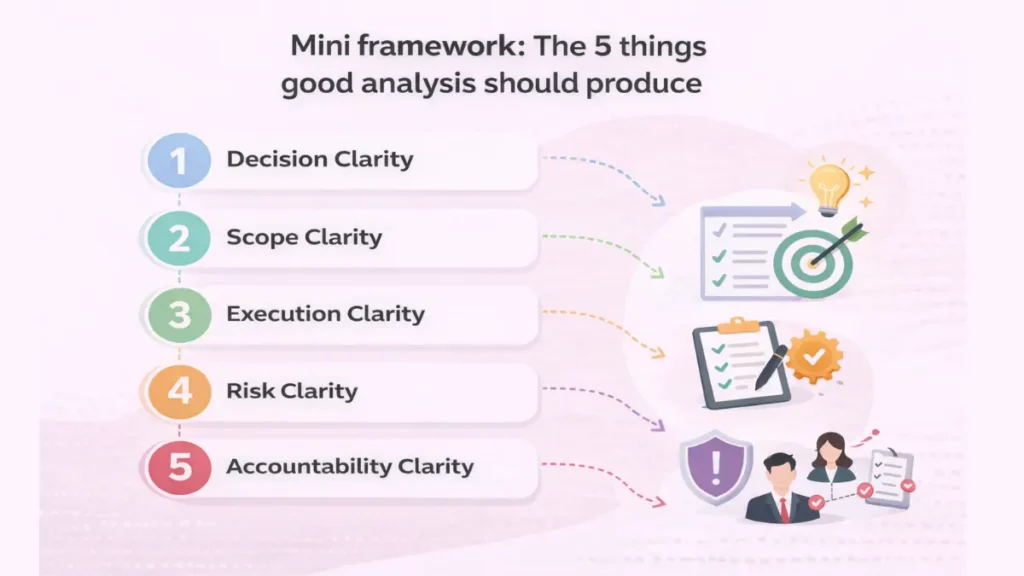
If analysis does not produce these five outcomes, you have every right to be skeptical about your vendor.
- Decision clarity
What problem are we solving, for whom, and why now? - Scope clarity
What is in, what is out, and what is deferred? - Execution clarity
What sequence makes sense, what dependencies exist, and what must be ready first? - Risk clarity
What could fail (data quality, adoption, compliance, vendor dependencies, security, timing)? - Accountability clarity
Who owns which decisions, inputs, approvals, and operational changes?
What should “industry-standard” analysis output look like?
This is a practical, synthesized version of a typical analysis phase in digital transformation and IT projects. Good companies may name or structure it a bit differently, but the core is usually the same
- A clear picture of how things work today: Where we are now
- A clear picture of what should change: Where we want to go
- A clear list of what the solution must do: What must be built/changed
- A list of key assumptions and limits: What could block us
- A risk map: What risks could we put on paper
- A phased plan with priorities: What we do first (and why)
- A realistic cost and effort estimate: What it will likely take
- A decision and governance setup: Who decides and owns what
- A change impact summary: Who needs to change how they work
Why is this even more important now in the EU digital context?
The pressure to digitize is real, and so are the execution constraints.
The EU has explicit digital targets for 2030. This includes 75% of companies using cloud/AI/big data and more than 90% of SMEs reaching at least basic digital intensity.
With AI bombarding us from all angles, many organizations are being pushed to modernize while still lacking skills and operating capacity.
Eurostat also reports that AI use is growing (13.5% of EU enterprises with 10+ employees in 2024, up from 8.0% in 2023), and cloud usage continues to rise.
That’s good news.
But adoption growth increases the cost of weak planning.
As digital adoption expands, complexity expands. You don’t need to manage just one system. You need to manage interdependencies across platforms, vendors, data ownership, security requirements, decision rights, and whatnot.
That’s where you need an experienced vendor or a better skillset.
Common mistakes in the analysis phase
Most analysis failures are caused by rushed decisions, unclear ownership, and “let’s just start” pressure. The results are predictable once you’ve seen enough:
- Treating analysis like paperwork
You just get a lot of documents. - Starting with a pre-picked solution
The team ends up justifying a tool instead of solving the real problem. - Skipping the real current-state review
Meetings describe an ideal process, not the messy one people actually use.. - Giving exact budgets and timelines too early
It creates false confidence and painful renegotiation later. - Ignoring data and integrations
The software looks fine until the systems need to talk to each other. - Bringing security and NIS2 compliance late
Issues surface late, when fixes are slower and more expensive. - Ignoring the change impact on teams
The system goes live, but people are not ready to use it properly. - Ending analysis without a phased plan
The project starts building without a clear order of operations.
The real cost is not the analysis
Executives do not pay for analysis because they enjoy planning. They pay for it because a serious transformation requires understanding where you are right now.
Good analysis makes risk visible early, while you still have room to choose wisely.
That is not overhead. That is good leadership.
Similar insights

Who Owns What in Change Management for Digital Transformation
18/03/2026
Inside Europe’s Cybersecurity Skill Shortage in 2026
17/02/2026
Which Software Development Process Is Best for Your Company?
10/02/2026
How To Know If Your Business Is Ready To Scale Internationally
21/01/2026
8 Hybrid Commerce Mistakes Companies Repeat in 2026
13/01/2026
Smart Workflows: AI Tools and Tips for Busy Leaders
16/12/2025
Supply Chain Attacks: Rethinking Third-Party Trust
10/12/2025
Choosing the Right Tech Stack in Uncertain Times
25/11/2025
How to Pitch and Get Your Ideas Approved at Work
12/11/2025
Let the success
journey begin
Our goal is to help take your organization to new heights of success through innovative digital solutions. Let us work together to turn your dreams into reality.

