




Agile or Waterfall, Scrum or Kanban, DevOps or “traditional IT”?
The argument for each is entertaining, but it also hides a more uncomfortable truth. None of these models is inherently “better”. They are simply, well, different…
The more useful question is not “Which methodology should we adopt?” but “What kind of problems are we trying to solve, with which people, in which environment?”
In other words, software development models are design choices for how your company thinks, decides, and delivers. Once you start looking at them that way, the conversation becomes far more deliberate. Let’s take a closer look and remedy your itch for a change.
The Methodology Maze: Understanding Your Options
Before deciding on a path, it helps to understand the landscape. Let’s briefly look at the leading software development processes (for a deeper dive, check this comprehensive guide to software development process) and what they offer.
Waterfall: The grand plan (when you know exactly what you need)
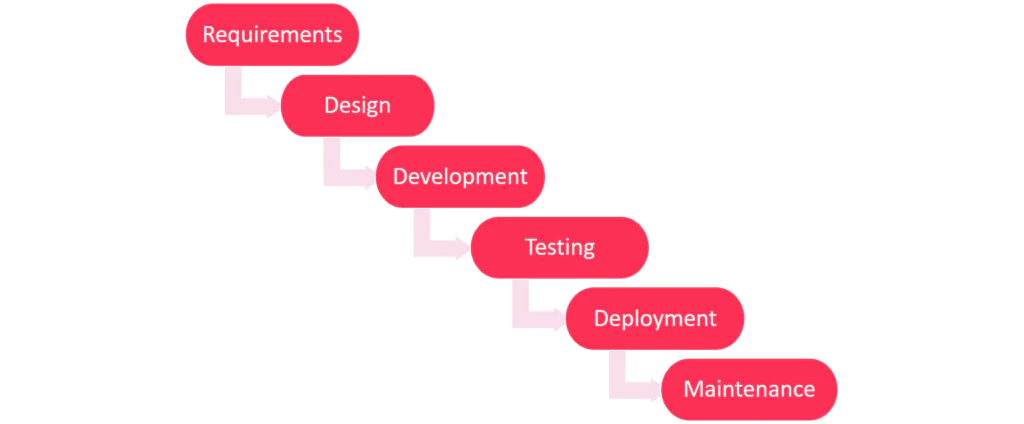
Waterfall is the classic “plan it all first, build it later” model. You define requirements, design the system, then implement, test, and deliver in strict sequence.
It works best when the scope is stable, risks are well understood, and regulators expect clear documentation and sign-offs. For example, it’s very useful in parts of healthcare, manufacturing, or public infrastructure.
The upside is predictability. Stakeholders see that a detailed upfront plan, budgets, and timelines are easier to fix, and governance is straightforward.
The downside is that change is expensive. If assumptions turn out to be wrong or the market shifts, a Waterfall project struggles to adapt midstream.
Agile & Scrum: Learning your way forward

Agile is disciplined exploration. It is a family of iterative approaches that deliver software in small increments, collect feedback, and adjust course fast.
Scrum is the most common implementation in software teams. There are short sprints, a clear backlog, and regular reviews where stakeholders see working features instead of slideware.
Agile and Scrum fit best where requirements are uncertain, markets move quickly, and you need to learn from users as you build.
Lean & Kanban: Smoother flow, less waste

Lean thinking focuses on reducing waste and delivering only what creates value. Kanban is its most common expression in software: a visual board, limited work-in-progress, and continuous pull of tasks.
It suits teams handling steady streams of small changes or support work, where cycle time and transparency matter more than sprint ceremonies.
You see it most in product teams running live SaaS platforms, internal IT and support teams, and companies with continuous change rather than big-bang projects.
DevOps: Build, ship, and run as one system

DevOps closes the gap between development and operations through the evolution of automation, continuous integration, and continuous delivery.
The point is not speed for its own sake, but reliable and repeatable releases and choosing the right tech stack.
It fits businesses where updates are frequent, uptime is critical, and feedback from production is as valuable as feedback from customers. It is most common in cloud-native companies, digital platforms, fintech, and high-traffic commerce products, but increasingly also in more traditional sectors that are modernising large core systems.
Hybrid models: Tailor the method to the work
Most companies quietly blend models. You might plan at a Waterfall level for budgets and compliance, while delivering increments with Scrum and deploying through DevOps. Or run Agile for software and a more sequential model for hardware.
Hybrids acknowledge that different kinds of work have different rhythms, constraints, and decision horizons.
They are especially common in larger organisations and regulated industries such as the public sector, healthtech, financial services, and manufacturing, where teams must satisfy both agility and formal governance.
7 Key Factors in Choosing Your Development Process

Now that we’ve toured the main options, how do you decide which process (or mix of processes) is best for your company? The decision should be rooted in your specific context and goals.
Here are some key factors to consider:
1. How complex and uncertain is your project?
Is your project well-understood and straightforward, or is it innovative with lots of unknowns?
Usually, high-uncertainty, complex projects benefit from iterative approaches (Agile/Lean), because you discover the true shape of the solution as you go. Conversely, a project that’s been done many times before (say, a routine system implementation) might run fine with a linear model.
Choose the approach based on the project, not fashion.
If you anticipate frequent changes or you’re essentially doing R&D, agile methods will handle changes more gracefully. If everything is crystal clear up front (a rarity, but it happens), a structured approach can march to the finish line.
2. How involved do your stakeholders want to be?
Consider your stakeholders (customers, end-users, executives). Do they want to be closely involved throughout the project, regularly giving feedback and seeing interim results?
If so, Agile/Scrum or Kanban aligns well with that. They offer frequent demos and opportunities to course-correct.
On the other hand, some clients or sponsors prefer a fixed plan and don’t have time to engage every week; they just want the final delivery per spec. A Waterfall model caters to that expectation (though you might educate them on the risks of late feedback).
In Europe, we often encounter both types. For example, a startup founder in Benelux may sit with the dev team every day (Agile paradise), whereas a government agency in, say, Germany might need formal sign-offs and quarterly reports (more Waterfall-like). Your development process should reflect how your stakeholders expect to collaborate (or not).
3. How urgent is your time to market?
Do you need to get something out quickly and then build on it?
Agile’s incremental delivery is superb for that. You release a minimal viable product fast, then improve continuously. If first-to-market is crucial, the ability to iterate and deploy frequently (possibly aided by DevOps) will be key.
However, if you have a hard deadline with a full feature set (e.g., a software for an event that must launch by a specific date with complete functionality), you may incorporate some Waterfall-style planning to ensure nothing critical slips through, even if you execute in sprints.
4. What do regulators and quality standards demand from you?
Industries like healthcare, finance, or the public sector often have non-negotiable requirements around documentation, testing, and approvals. This doesn’t rule out Agile, but it does mean you’ll need a hybrid approach.
For instance, in a healthtech project we’ve seen, the team used Agile development internally. Still, they produced extensive design control documents and underwent formal validation at the end (a nod to Waterfall) to satisfy medical regulators.
If your company must comply with standards (ISO, GDPR, etc.), factor that in.
Agile can meet rigorous standards, but it might require extra discipline. In some cases, a V-Model (an offshoot of Waterfall that pairs each dev phase with a testing phase) could be useful to ensure verification at every step.
The key is not to let process ideology compromise critical quality steps. Build those in by design.
5. How big and experienced is your team?
A small, co-located, cross-functional team can usually adopt Agile methods quite easily. There, communication is fluid, and everyone wears multiple hats.
Large teams or multiple teams coordinating a big project introduce complexity. Frameworks like Scaled Agile (SAFe) or enterprise Scrum exist to manage agile at scale, but they add overhead.
Sometimes, large organizations find a mix works. Small sub-teams are agile, but coordination happens in a more structured program management fashion.
Also, be honest about your team’s experience.
Agile demands skill in estimation, self-organization, and technical practices like refactoring and test automation. If your team is junior or new to a domain, upfront planning or mentorship might save them from thrashing.
On the flip side, an experienced team often gets irritated by too much process. They might prefer Lean/Kanban with minimal ceremonies, focusing on getting things done.
Choose a methodology that matches your people’s capabilities with an eye toward where you want to grow them. Don’t force a completely foreign process overnight without training. That’s a recipe for frustration.
6. What does your culture naturally support?
Perhaps the most important factor is your organization’s culture and how supportive it is.
- Are you a fast-moving startup with a “try it and see” mindset? Agile will feel natural.
- Are you a more traditional firm with layers of approval and a cautious outlook? You may need to proceed incrementally – perhaps piloting Agile in one team while others stick to familiar routines.
Keep in mind that process change is change management.
People will have habits and even power structures built around the old way. A project manager used to detailed Gantt charts might feel lost or resistant in a Scrum team without proper guidance.
It’s crucial to get buy-in across the board.
Sometimes the best approach is an incremental one. You can introduce agile practices one by one (daily stand-ups, then iterative planning, and so on) instead of all at once.
In other cases, a bolder reboot is needed (if the old process is completely failing). Know your culture’s tolerance for change.
Remember, every engineering team is different and has its own unique set of needs. Your process should be molded to serve your people and goals, not the other way around.
7. What can your tools and infrastructure realistically support?
Be realistic about your technology environment.
If you don’t have automated testing or continuous integration set up, moving to an Agile/DevOps model will require that investment. Otherwise, you’ll go “agile” in name but drown in manual testing and slow releases.
Similarly, if your customers or internal users can’t handle frequent updates (imagine a client who can only install a new version of your software once a year due to their own constraints), a continuous delivery approach might clash with reality.
Align your methodology with what your tooling can support today.
It might be that you start with a hybrid approach, and as you choose your tech stack, you can evolve into more agility.
Pragmatism is key here. It’s better to do a slightly slower process well than to declare “We’re doing DevOps!” but have every deployment break because the systems aren’t ready.
This is where our clients find our Digital Architecture Analysis very useful.
People, People, People! (Over Processes)

No process will save a project if the team isn’t motivated, trained, and empowered to use it well. In fact, one of the biggest mistakes companies make is becoming too process-centric and forgetting the human factor.
A methodology is only as effective as the people implementing it.
Change is genuinely hard for organisations
If your organization has been doing Waterfall for 10 years and you decide to “go Agile,” expect turbulence.
People might fear the unknown. They might misapply the new practices due to lack of understanding.
Training and mentoring are crucial here. Send folks to workshops, bring in an experienced agile coach if needed, or pair teams with internal champions who have done it before.
And be patient. There will be a learning curve.
Agile needs the right environment to thrive
Agile, for instance, thrives in a culture of trust, transparency, and collaboration. Team members need to feel safe to speak up about problems, to experiment, and yes, to fail and learn.
If your corporate culture is very hierarchical and blame-oriented, just adopting Scrum ceremonies won’t magically bring agility. Leaders may need to adjust their style.
In Europe, many organizations with long-established management traditions have found this to be the toughest part of seing digital transformation ROI. Not the mechanics of stand-up meetings, but the mindset shift towards empowering teams.
Avoid methodology dogma at all costs
One thing intelligent teams detest is doing something “because some book said so.” If a particular practice isn’t adding value, discuss it.
For example, maybe your team finds daily stand-up meetings are too frequent and opt for three times a week, or they decide to use Kanban instead of time-boxed sprints because it fits their work better. That’s okay.
The spirit of methodologies matters more than the rituals.
Communication is the lubricant for any process shift
In any process change, communicate the why behind it to everyone involved. People are much more likely to support a change if they understand the reasoning.
Communicate early wins and be transparent about challenges.
Did the first sprint uncover a requirement that would have sunk a Waterfall plan? Celebrate that learning. Did your attempt at continuous deployment lead to a production outage? Analyse it and improve.
Leadership has to set the tone for pragmatism
Leadership must set the tone that the process is there to serve people, not the other way around.
If developers feel a methodology is being imposed, they will be skeptical. If they see leadership being flexible, keeping what works, discarding what doesn’t, they will engage more.
The goal is agility, not necessarily “Agile.”
In the end, pragmatism outperforms doctrine
The industry loves to argue about which methodology is superior.
In practice, the winners are not the loudest evangelists. They are the companies that understand the real constraints of their domain, select a process that fits those constraints, and then keep refining it as their products, teams, and markets evolve.
Methodology is not ideology. It is a design choice for how you learn, decide and deliver.
Similar insights

Who Owns What in Change Management for Digital Transformation
18/03/2026
“Why Do We Pay for Analysis?” an Answer for Skeptical Executives
11/03/2026
Inside Europe’s Cybersecurity Skill Shortage in 2026
17/02/2026
How To Know If Your Business Is Ready To Scale Internationally
21/01/2026
8 Hybrid Commerce Mistakes Companies Repeat in 2026
13/01/2026
Smart Workflows: AI Tools and Tips for Busy Leaders
16/12/2025
Supply Chain Attacks: Rethinking Third-Party Trust
10/12/2025
Choosing the Right Tech Stack in Uncertain Times
25/11/2025
How to Pitch and Get Your Ideas Approved at Work
12/11/2025
Let the success
journey begin
Our goal is to help take your organization to new heights of success through innovative digital solutions. Let us work together to turn your dreams into reality.

