


If a supervisor called your company next month, they would look for the proof.
Who reviewed the risks, on what date, and what they decided. Which tests were run, what the tests found, and what was fixed afterwards. Who approved the current version of your security measures, and when?
Three major laws now expect you to demonstrate that your controls operate.
This piece is for leaders who already have the policies and want to know what else is expected. We will look at exactly what each law asks for, where the gap usually sits, and how to build a simple evidence register that solves most of the problem.
Key Takeaways
- Having a policy and being able to prove it works are two different things. European regulators now ask for the second one.
- NIS2 gives authorities the power to request “evidence of implementation of cybersecurity policies.” That wording is in the directive itself.
- DORA requires a documented framework reviewed at least once a year, a register of all ICT supplier arrangements, and a formal process for closing audit findings.
- The AI Act requires logs, technical documentation, and record-keeping. Most of these duties start in December 2027, so there is still time to prepare.
- A policy states your intention. Evidence is what the work leaves behind. Supervisors ask for the second kind.
- The practical answer is an evidence register: for each duty, what proves it, who produces it, and how often.
What do the three laws have in common
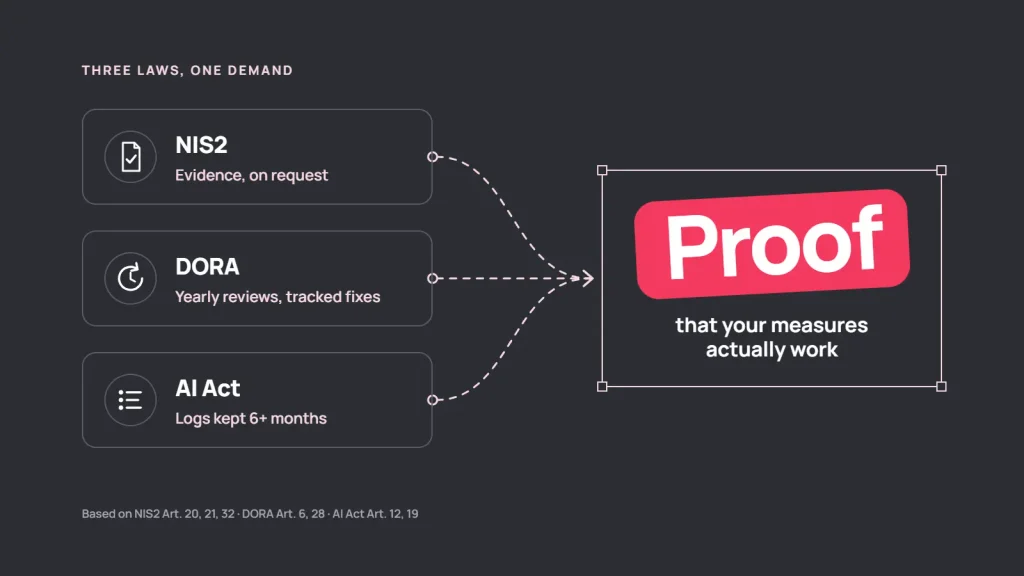
These three laws cover different subjects. Read their text closely, and you’ll find out they ask for the same thing.
NIS2 asks for evidence by name
NIS2 (Directive (EU) 2022/2555) is the clearest example. Article 32 lists what national authorities may do when supervising essential entities. Among these powers, Article 32(2)(g) allows them to make:
“requests for evidence of implementation of cybersecurity policies”
The same article allows on-site inspections, security audits by an independent body, and requests for access to documents.
There is a second requirement that matters even more, because it applies all the time rather than only during an inspection. Article 21(2)(f) lists, among the required security measures, “policies and procedures to assess the effectiveness of cybersecurity risk-management measures.”
If you read that slowly, you are required to check whether your own measures work. Which means you are required to produce the results of those checks.
And Article 20(1) places approval and oversight of these measures with the management body, with liability attached. We covered what that means for directors in our piece on board liability under NIS2.
DORA asks for a rhythm, not a document
DORA (Regulation (EU) 2022/2554) has applied to financial entities since 17 January 2025. Its documentation duties are precise.
Article 6(5) requires the ICT risk management framework to be documented and reviewed at least once a year. A review is also required after a major ICT incident, after instructions from a supervisor, or after conclusions from resilience testing or audits. A report on the review must be given to the competent authority on request.
Article 6(7) goes further. Based on internal audit conclusions, the entity must set up a formal follow-up process, including rules for timely verification and remediation of critical findings.
That is an unusual and useful requirement. It is not enough to find problems. You have to be able to show what happened to them afterwards.
Article 28(3) adds the register of information: a record of all contractual arrangements for ICT services from third-party providers, kept at entity level and at group level, with critical functions separated from the rest. At least once a year, entities report on new arrangements and the categories of providers involved. The full register goes to the authority on request.
If your company has never listed its suppliers and the connections between them, this is a large piece of work. It is also the same inventory problem we described in integration debt.
The AI Act asks for logs and gives you time
The AI Act (Regulation (EU) 2024/1689) is the newest of the three, and its timing has changed, so it is worth being precise.
Some parts already apply. The bans on certain practices have been in effect since 2 February 2025. Rules for general-purpose AI models have applied since 2 August 2025. The transparency duties in Article 50, which include telling people when they are dealing with an AI system, have applied since 2 August 2026.
The heavy documentation duties for high-risk systems were postponed by the Digital Omnibus amendments, Regulation (EU) 2026/1744. For high-risk systems listed in Annex III, they now apply from 2 December 2027, and for those under Annex I, from 2 August 2028.
When they arrive, they are demanding. Article 12 requires high-risk AI systems to allow automatic recording of events across the lifetime of the system. Article 19 requires providers to keep those logs for a period suited to the system’s purpose, and “of at least six months.” Article 11 and Annex IV require technical documentation. Article 17 requires a quality management system.
So, for AI, you have about a year to put this in place. That is a comfortable position, and only if the work starts.
The gap is already visible to regulators
You do not have to guess whether companies are struggling with this. The EU’s own cybersecurity agency measures it.
ENISA publishes the NIS360 report, which assesses the maturity of the sectors covered by NIS2. The 2026 edition, published in May, contains one observation that describes this problem exactly. Companies report that incident response testing happens regularly. The supervisory activities of national authorities do not show the same picture.
Two things can explain that gap. Either the testing is not happening as often as companies believe, or it is happening and cannot be demonstrated. Both are evidence problems.
This is the gap we built Cyberatlas to close. It runs cybersecurity tabletop exercises and keeps the record: the scenario, who took part, the decisions they made, a transcript in English, Estonian or German, and an evaluation against criteria you set yourself. The rehearsal improves the team. The record is what you can show a year later.
Other findings point in the same direction. Only about one-third of public administrations carry out full, regular security assessments. Among managed service providers, ENISA found that assessment of control effectiveness was often fragmented and done case by case. Around half of cloud and data centre providers say risks are recorded, but not systematically prioritised or treated.
Recorded, but not treated. That is a sentence worth repeating at a management meeting.
Policies state intent. Evidence is what work leaves behind
You cannot write evidence in advance. You can only collect it, or fail to.
This is why “we have the policy” is a weaker answer than most management teams expect. The policy says nothing about the twelve months that followed.
There is a second, less obvious point.
Evidence that shows problems is usually stronger than evidence that shows none.
An exception log with no entries does not prove that no exceptions occurred. It suggests nobody was looking. A test report with findings, each one assigned to a person and closed on a date, is far more convincing than a clean report with nothing in it.
DORA says this almost directly in Article 6(7), with its requirement for a follow-up process on critical findings.
The evidence register
This is the practical tool, and it is simple enough to start in a spreadsheet this week.
For every duty that applies to you, record four things: what the duty is, what artefact proves it, who produces that artefact, and how often.
Here is a worked example using real obligations from the three laws.
| The duty | Where it comes from | What proves it | Who produces it | How often |
| The management body approves the security measures | NIS2 Art. 20(1) | Dated board minute naming the measures and the version approved | Board secretary | On approval, then yearly |
| Management body members are trained | NIS2 Art. 20(2) | Training records with names, dates and subjects covered | HR | Yearly |
| You assess whether your measures are effective | NIS2 Art. 21(2)(f) | Test and audit results, plus the list of what was changed afterwards | Security lead | Per the test plan |
| You can show the policies operate | NIS2 Art. 32(2)(g) | The evidence items for each control, held in one place | Each control owner | Continuously |
| The ICT risk framework is reviewed | DORA Art. 6(5) | Dated review report, and the reason for the review | Risk function | At least yearly |
| Audit findings are closed | DORA Art. 6(7) | Follow-up log: finding, owner, action, date closed | Internal audit | Per finding |
| ICT supplier arrangements are recorded | DORA Art. 28(3) | Register of information, entity and group level | Procurement with risk | Updated as it changes, reported yearly |
| High-risk AI system logs are kept | AI Act Art. 12 and 19 | Retention setting of at least six months, plus sample logs | System owner | Continuously |
| Technical documentation exists for the AI system | AI Act Art. 11 and Annex IV | The documentation file, with version history | Product owner | At release, and after changes |
Three rules of thumb make the register work.
Every row needs a person, not a department. “IT” does not produce evidence. A named person does. This is the same ownership principle behind a simple operating model, applied to proof.
The “how often” column is the most valuable one. It turns compliance from a project into a calendar. Most evidence failures are not refusals. They are things that were supposed to happen yearly and happened once.
Start with the rows you would struggle to fill. You do not need the full register before it becomes useful. Pick the five duties where a supervisor is most likely to ask, and fill those first. This is the same logic as minimum viable data. A small standard that people follow beats a complete one that nobody maintains.
You do not have to invent the evidence list
A useful detail that many companies miss: ENISA has already published examples of acceptable evidence, and it is free.
In June 2025, ENISA released its technical implementation guidance on cybersecurity risk-management measures. For each requirement, the document gives guidance, then a section called “examples of evidence,” and sometimes practical tips.
The examples are concrete. For roles and responsibilities, it names job descriptions and a list of security roles with contact details. For risk management, a documented risk management framework and a documented risk treatment plan. For compliance monitoring, logs of policy exceptions. For logging, simply that a retention period is set.
Even so, if you are in any NIS2 sector, this is the closest thing available to an official answer about what evidence looks like. National authorities may also use its detail when interpreting NIS2 more widely.
The Net Group view: Build the habit
We have worked on systems in regulated European environments for longer than we can remember
The companies that handle this well do something unglamorous. They decide who produces each piece of evidence, they agree on how often, and they let it accumulate as a by-product of normal work. Nobody has to prepare for an inspection because the material already exists.
That is also why the first 90 days after a system goes live matter so much. Evidence shows that habits form early, and they are difficult to start later, as we described in why most systems fail in the 90 days after launch.
So the question to put to your team is this:
If a supervisor asked us to prove that this policy operated last year, what would we send, who would find it, and how long would it take?
The answer to that question is your real compliance position.
Similar insights

How do you know it’s time to change a vendor?
10/11/2026
When to stop a digital transformation project
20/10/2026
Why Most Systems Fail in the 90 Days After Launch
13/10/2026
The integration debt you’re probably not budgeting for
15/09/2026
Your board can now be held liable for cyber risk (NIS2)
08/09/2026
The dangerous appeal of vibe coding: Know when, and when not
18/08/2026
Data Trust Score: After data readiness, you need trust
11/08/2026
Why digital transformation fails in the middle (management)
20/07/2026
Every digital system needs this simple operating model
14/07/2026
Let the success
journey begin
Our goal is to help take your organization to new heights of success through innovative digital solutions. Let us work together to turn your dreams into reality.

Net Group OÜ
A.H. Tammsaare tee 92
Tallinn 13423
Estonia

