







Most of the companies we talk to do not suffer from a lack of data. They suffer from data that is almost useful.
Customer records exist, but half the fields are optional. Reports exist, but different teams define the same metric differently. The list goes on.
The usual GPTesque answer is to “improve data quality.” But, again, too broad to be useful. It can turn into a long governance programme or a promise that one day the organisation will have nicely structured data.
A more practical starting point is minimum viable data and data readiness.
The problem with “clean data.”
Clean data is a tempting goal because it sounds responsible.
But clean data can also become an excuse for delay.
If every field must be cleaned, every system integrated, every definition aligned, and every historical record corrected, you may spend years preparing for value instead of creating it.
Minimum viable data works the other way. It reduces the size of the problem. It asks:
What data must be reliable for this ONE PROCESS to work?
What is minimum viable data?
Minimum viable data is the smallest agreed set of data fields, definitions, quality rules, ownership rules, and update standards required for a specific business process to work reliably. It means the minimum data that must exist and be trusted for reporting, handoffs, forecasting, automation, or AI to function
We really like the phrase “fit for purpose.” That is the point.
The purpose for the data comes first, and then you focus on making a fit. It all depends on what the data is supposed to help people or systems do.
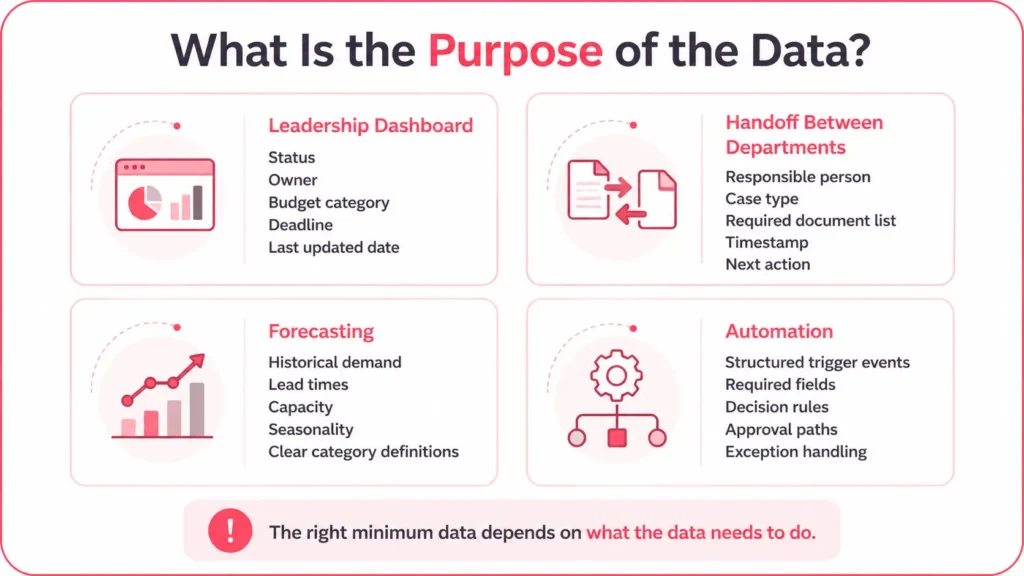
- For a leadership dashboard, minimum viable data may mean every project has a status, owner, budget category, deadline, and last updated date.
- For a handoff between departments, it may mean every request has a responsible person, a case type, a required document list, a timestamp, and a next action.
- For forecasting, it may mean historical demand, lead times, capacity, seasonality, and clear category definitions.
- For automation, it may mean structured trigger events, required fields, decision rules, approval paths, and exception handling.
The standard changes depending on the process.
The real question: What breaks if this is missing?
A useful minimum viable data conversation should start with consequences.
- What breaks if this field is missing?
- Who has to chase the answer manually?
- Which report becomes unreliable?
- Which decision gets delayed?
- Which customer, citizen, employee, or partner experiences friction?
- Which automation fails or creates risk?
A missing phone number may not matter in one process. In another, it stops a service team from contacting a citizen about an urgent case.
The same data point can be optional, useful, or mission-critical depending on the context. Minimum viable data forces that distinction.
It also creates accountability. If a field is critical, someone must own it. If a definition matters, teams must agree on it. If a value must be updated within 24 hours, that rule has to be visible in the process.
That is a useful mindset for leaders.
A minimum viable data standard is a contract between the people who create data and the people, reports, workflows, or systems that depend on it.
Minimum viable data is a leadership issue
Most of the time, data is an ownership problem.
If departments define the same metric differently, no system will magically create alignment. That is why minimum viable data needs leadership and all the people to be ready for data transformation.
What leaders should define before any new system
Before approving a new dashboard, workflow, automation project, or AI pilot, leaders should ask a few simple questions.
- What data must exist for this to work?
- Who creates that data?
- Who uses it next?
- Which fields can never be empty?
- Which definitions must be shared across teams?
- How fresh does the data need to be?
- What happens when the data is missing, outdated, or suspicious?
- Who is responsible for fixing it?
A digital system can only move as confidently as the data underneath it. If the basic inputs are unclear, the organisation just moves confusion through the system faster.
Minimum viable data for automation and AI
Automation is where weak data becomes expensive.
A person can often spot missing context, but a poor system cannot. It follows the rule it was given. If the trigger is wrong, the workflow starts at the wrong time. If the exception is not defined, the system sends the problem back to people.
AI raises the stakes even further. Minimum viable data for automation and AI should define:
- Which data is required before the process can start.
- Which values are allowed.
- Which exceptions need human review.
- Which source is authoritative.
- Which outputs must be logged.
- Which decisions cannot be automated without approval.
This is where responsible digital transformation becomes concrete. Not “let’s use AI.” But “let’s define the data conditions under which AI is allowed to support this process.”
How to start without boiling the ocean
Choose a process where poor data already creates visible friction: a leadership report, a citizen service, a customer handoff… Then define the minimum viable data standard for that process.
- Start with the outcome. What should improve?
- Map the handoffs. Where does information move?
- Identify the critical fields. What must be present?
- Agree on definitions. What does each field mean?
- Set quality rules. What counts as complete, valid, fresh, and usable?
- Assign ownership. Who is responsible at the point of creation?
- Create feedback. How will downstream teams report bad data back to the source?
- Measure the effect. Did the report become more trusted? Did the handoff become faster? Did automation need fewer manual corrections?
Minimum is not the final ambition
Once the minimum standard works, the organisation can raise it. More fields can be added. Validation can improve. Systems can be integrated. Ownership can become clearer. Automation can become safer. AI use cases can become more reliable.
But the first step is not perfection, and that is the real value of minimum viable data.
Similar insights

The integration debt you’re probably not budgeting for
15/09/2026
Your board can now be held liable for cyber risk (NIS2)
08/09/2026
The dangerous appeal of vibe coding: Know when, and when not
18/08/2026
Data Trust Score: After data readiness, you need trust
11/08/2026
Why digital transformation fails in the middle (management)
20/07/2026
Every digital system needs this simple operating model
14/07/2026
Stop buying projects. Start building digital capabilities.
16/06/2026
The hidden cost of “small changes” in digital projects
09/06/2026
AI is a great cost-saver – Until it’s not!
13/05/2026
Let the success
journey begin
Our goal is to help take your organization to new heights of success through innovative digital solutions. Let us work together to turn your dreams into reality.

