







Across the EU, companies are increasing their digital intensity, but the people side is lagging.
Just look at how much we talk about AI, and still, it feels like we’re using hammers to crack nuts.
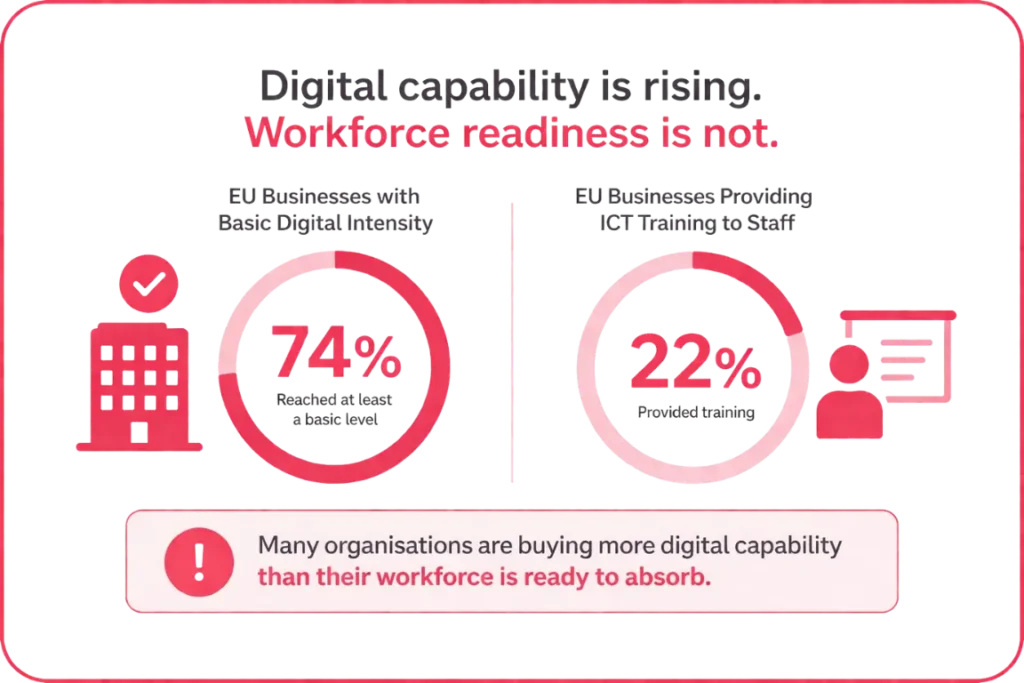
In 2024, 74% of EU businesses reached at least a basic level of digital intensity. But only 22% provided ICT training to staff. In other words, many organisations are buying more digital capability than their workforce is ready to absorb.
Quick takes
- Treat people’s readiness as a risk, instead of a side topic.
- Do not mistake system rollout for adoption. Going live has nothing to do with changing work-as-it-was.
- If managers cannot explain the change in practical terms, teams will default to old habits.
- External IT support can build the solution, but it cannot create internal ownership. You need to do this part.
- Training only works when it is role-specific, tied to daily work, and reinforced after launch.
- If old approvals, spreadsheets, and workarounds still exist, the new process is not really in place.
Why people’s readiness matters so much
Software changes nothing on its own. Yes, we’re the software company, but we refuse to wear rose-coloured glasses simply because we want to see our clients win.
And you win when people understand what they are expected to do differently starting from August, for instance.
McKinsey’s transformation research shows that transformation success rates are still very low. What’s more, successful companies are far more likely to provoke behaviour changes rather than relying on just technology.

Here’s a useful reality check. More than a quarter of Europe’s workforce is already experimenting with AI at work. The change is inevitable, whether you get your workforce to prepare or not. That does not mean everyone needs to become technical, but it means the pace of work redesign is already here.
What does “people readiness” actually mean?
People readiness is whether leaders, managers, and teams are prepared to behave differently, use the new system properly, and stop using the old workarounds.
A company is usually people-ready when five things are true: the case for change is clear, the changed behaviours are specific, managers are aligned, skills and time are in place, and systems and reporting reinforce the new way instead of rewarding the old one.
That framing aligns with the behaviour-change factors McKinsey links to stronger transformation and with what we at Net Group practice in our work.
Self-evaluation checklist: Are your people actually ready?
Score each line from 0 to 2.
0 = no
1 = partly / inconsistently
2 = yes, with evidence
| Check | Best when | Watch-outs | Score |
| 1. Can leaders explain the business reason for the change in the same words? | The case is about service, speed, cost, risk, or control — not “because IT said so.” | Each executive tells a different story. | 0–2 |
| 2. Have you defined what people must do differently? | New behaviours are concrete: where work starts, who approves, what system becomes the source of truth. | Goals are abstract: “be more digital,” “adopt the platform.” | 0–2 |
| 3. Are middle managers ready to translate the change into daily work? | Managers know what changes for their team this month, this quarter, and what to stop doing. | Managers support the idea but cannot explain local impact. | 0–2 |
| 4. Have you made room for adoption in people’s actual workload? | Training, migration, and process clean-up are planned into capacity. | Adoption is treated as extra work on top of BAU. | 0–2 |
| 5. Are incentives and controls aligned with the new way? | KPIs, approvals, reporting, and governance reward use of the new process. | Old spreadsheets and backdoor approvals remain tolerated. | 0–2 |
| 6. Do people have role-based support, not generic training? | Training is tailored by role, with examples from real work. | One mass session, one PDF, no follow-up. | 0–2 |
| 7. Do you have a way to hear resistance early? | Teams can raise friction points, and somebody acts on them fast. | Silence gets mistaken for buy-in. | 0–2 |
| 8. Are you measuring adoption, not just rollout? | You track real usage, cycle time, error rates, rework, and shadow-process behaviour. | Reporting focuses on launch dates and training attendance. | 0–2 |
How to read the score
| Total | What it usually means | What to do next |
| 0–5 | High risk. You are treating transformation as a technology deployment. | Stop and fix leadership alignment, manager readiness, and adoption metrics first. |
| 6–10 | Partial readiness. A pilot may work; a wide rollout probably will not. | Narrow scope, remove workload conflicts, tighten manager accountability. |
| 11–13 | Reasonable base. Execution discipline now matters more than intent. | Proceed in stages and monitor shadow behaviour closely. |
| 14–16 | Strong readiness. You have a real chance of adoption at scale. | Move, but keep feedback loops active and reinforce the new operating model. |
Where do companies usually score lower than they expect?
Executives often approve the programme and IT delivers the tooling. But then the manager gets left with:
- keep operations stable,
- learn the new process,
- coach the team,
- clean legacy data, and
- hit the same targets as before.
This is where ‘management’ can’t really ‘manage’.
The second weak point is reinforcement. Those include structures inside the company that push people to use the new way of working.
People are much more likely to change when the why is clear, leaders role model the behaviour, skills are built, and formal mechanisms reinforce the change.
If even one of those is missing, people revert to the old.
Common mistakes that make adoption look better than it is
| Mistake | Why it fails | Better move |
| Calling it “an IT project” | It strips line managers of ownership. | Name one business owner and one operational owner. |
| Measuring training completion as success | Attendance does not equal behaviour change. | Measure usage, exceptions, rework, and time saved. |
| Keeping old approvals alive “for flexibility” | Parallel systems become the real system. | Set a cut-off date and enforce one source of truth. |
| Sending one generic change message | People do not hear what changes for them. | Tailor the message by function and role. |
| Overloading high performers | The same few people carry the whole change. | Protect key people’s capacity and spread ownership. |
What should you do next if your score is mediocre?
Fix the operating conditions.
Start with three moves.
First, rewrite the change in business language for each affected team: what starts, what stops, what gets easier, what gets measured.
Second, give middle managers a simple adoption brief, not a slogan.
Third, identify and remove the old mechanisms that still reward legacy behaviour.
If the old system, spreadsheet, approval path, or KPI still feels safer than the new one, people will default to old.
What to read next?
If this checklist shows weak spots, the issue is not in the software or motivation. It is in ownership.
Most organisations fail to define who carries out transformation through the business once the technology is in place. We explored that problem in more detail in our recent piece, Who owns what in change management for digital transformation? Read that next if you want a clearer view of where vendor responsibility ends, and internal ownership has to begin.
Similar insights

The integration debt you’re probably not budgeting for
15/09/2026
Your board can now be held liable for cyber risk (NIS2)
08/09/2026
The dangerous appeal of vibe coding: Know when, and when not
18/08/2026
Data Trust Score: After data readiness, you need trust
11/08/2026
Why digital transformation fails in the middle (management)
20/07/2026
Every digital system needs this simple operating model
14/07/2026
Stop buying projects. Start building digital capabilities.
16/06/2026
The hidden cost of “small changes” in digital projects
09/06/2026
Minimum Viable Data: The standard all digital systems need
19/05/2026
Let the success
journey begin
Our goal is to help take your organization to new heights of success through innovative digital solutions. Let us work together to turn your dreams into reality.

