







AI is saving costs, right?
Well, frankly, it is. But there is a small problem with the way many leaders talk about AI savings.
They count the cost they want to remove, and they forget to count the cost they are about to create.
This piece is for business leaders who want to understand where AI implementation costs really hide. You’ll find out why “AI saves money” is too simple and how to estimate real costs before committing.
The AI adoption story sounds better than the AI value story
McKinsey’s 2025 global survey found that 88% of respondents say their organizations regularly use AI in at least one business function. But only around one-third say their companies have begun to scale AI programs. They note that most organizations have not embedded AI deeply enough into workflows to realize true benefits.
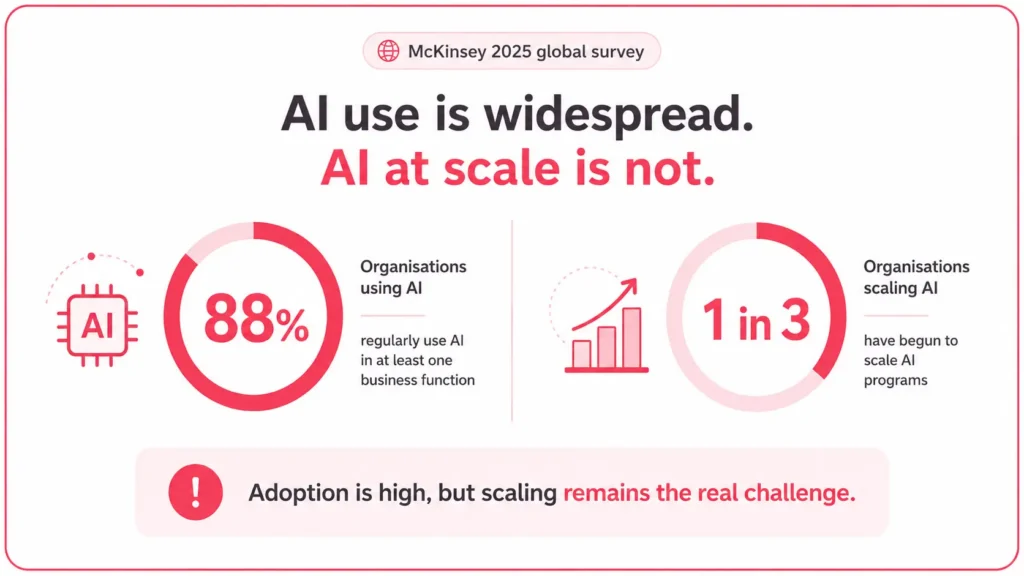
We talked about this recently in our data readiness piece because that gap matters. It means the market is not struggling to try AI. The market is struggling to operationalize AI.
IBM’s 2025 CEO study tells a similar story. Surveyed CEOs reported that only 25% of AI initiatives had delivered expected ROI over the last few years, and only 16% had scaled enterprise-wide. The same study found that 50% of CEOs said rapid investment had left their organization with disconnected technology.
This is the real AI cost problem. We buy the promise before pricing the operating reality.
The first flaw: Treating AI like cheaper labor
The most common AI cost-saving logic sounds something like this:
“This task takes 10 people. AI can do 40% of it. Therefore, we save 4 people’s worth of cost.”
Most of the time, it’s wrong.
AI rarely lands inside a business as a clean replacement for human work. It comes on top of messy workflows, legacy systems, scattered data, unclear ownership, exceptions, approvals, compliance requirements, and people who are not ready for the change.
So the first serious question is: “What must change around the work before AI can automate anything?”
If five departments handle the same customer request in five different ways, AI will not magically create efficiency.
This is why McKinsey found that workflow redesign is one of the strongest contributors to meaningful AI business impact. AI high performers are nearly three times more likely than others to have fundamentally redesigned individual workflows.
Where the costs of AI implementation hide
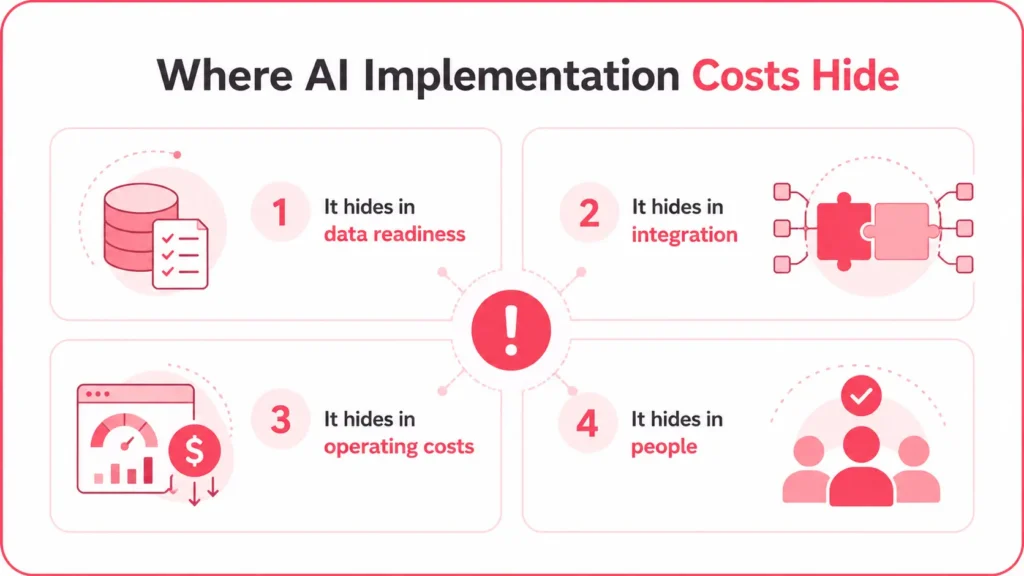
It hides in data readiness.
Gartner predicts that through 2026, organizations will abandon 60% of AI projects that are not supported by AI-ready data.
They also warn that AI-ready data is not a one-time exercise. It requires ongoing work around metadata, data observability, governance, pipelines, and live production requirements.
It hides in integration.
AI becomes useful when it can work with the systems: ERP, CRM, document repositories, customer portals, internal tools, finance systems, etc.
A chatbot outside the workflow is a demo. An AI solution connected to the workflow is an implementation.
It hides in governance and risk.
S&P Global Market Intelligence data reported by CIO Dive found that the share of companies abandoning most of their AI initiatives jumped from 17% to 42% year over year.
The average organization scrapped 46% of AI proofs-of-concept before production, with cost, data privacy, and security risks named as top obstacles.
It hides in operating costs.
Gartner’s 2026 analysis of failed GenAI projects points out that costs can look negligible in a proof of concept. They become a problem when usage expands across thousands of users and dozens of use cases.
Plus, in a prototype, AI feels almost free. A small team tests a few prompts and uses limited data. You get impressive outputs quickly.
Production is different. Once AI becomes part of daily work, costs start to compound in very practical ways:
- More tokens: Longer prompts, documents, instructions, and answers increase model usage.
- More API calls: One user request may trigger several AI steps behind the scenes.
- More context: The model may need customer data, policies, history, or product information to give a useful answer.
- More users: A few test prompts can become thousands of daily requests.
- More infrastructure: Search, databases, permissions, logging, monitoring, and security add cost.
- More quality control: Real AI systems need testing, review, updates, and human oversight.
And it hides in people.
Deloitte’s 2025 AI ROI research found that true AI ROI leaders treat AI as enterprise transformation. They invest in ownership, AI fluency, human-centered change, different ROI timeframes, and architecture choices that support scale.
This is why “AI will save us money” is too vague to be useful.
- Which money?
- In which process?
- After which implementation costs?
- Over what timeline?
- With which operating model?
The Net Group View: AI should fit reality
At Net Group, we are more skeptical than fashionable.
Not skeptical about AI itself. We built dozens of AI-powered solutions. We just know for a fact that making AI work is easier said than done.
The job is to understand what is worth your time, what is hype, and how to combine existing solutions into tools that fit daily work.
That last phrase is the heart of it. Daily work.
AI that looks impressive in a boardroom but does not survive daily work is just a theater.
How to estimate AI implementation costs before you commit
Before committing to an AI initiative, leaders should build a simple implementation cost map. And don’t worry, because you don’t need a 70-page strategy document.
Start with these categories:
- Cost of process redesign: What workflows need to change before AI can be useful? Who needs to approve those changes? Which exceptions still require humans?
- Cost of data readiness: What data needs to be cleaned, structured, labeled, connected, governed, or made searchable?
- Cost of integration: Which systems must the AI solution connect to? How will authentication, permissions, APIs, logs, and fallback processes work?
- Cost of security and compliance: What risks appear when AI touches customer data, internal documents, financial information, public services, or regulated workflows?
- Cost of people and adoption: Who needs training? Who will resist? Who will own the new workflow? What roles change?
- Cost of ongoing operations: Who monitors quality? Who handles failures? Who updates prompts, models, data pipelines, policies, and evaluation criteria?
- Cost of not doing it: What manual cost, delay, risk, or customer friction continues if the company avoids implementation?
Again, we are not arguing against AI investment. Avoiding AI also has a cost. We are just arguing against lazy AI implementation.
The cost-saver comes after the cost-clarifier
AI can absolutely save costs. But before it does it clarifies them.
It shows where:
- data is weak
- processes are inconsistent
- teams rely on informal knowledge
- systems do not speak to each other
- governance was assumed but never designed
- manual work was actually human glue holding together a fragile process
Once those costs are visible, leaders can make better decisions. They can choose the right use cases and build the right foundations.
AI becomes cost-effective when the business is ready enough to use it well.
Similar insights

Why Most Systems Fail in the 90 Days After Launch
13/10/2026
The integration debt you’re probably not budgeting for
15/09/2026
Your board can now be held liable for cyber risk (NIS2)
08/09/2026
The dangerous appeal of vibe coding: Know when, and when not
18/08/2026
Data Trust Score: After data readiness, you need trust
11/08/2026
Why digital transformation fails in the middle (management)
20/07/2026
Every digital system needs this simple operating model
14/07/2026
Stop buying projects. Start building digital capabilities.
16/06/2026
The hidden cost of “small changes” in digital projects
09/06/2026
Let the success
journey begin
Our goal is to help take your organization to new heights of success through innovative digital solutions. Let us work together to turn your dreams into reality.

