







Many companies we work with do not have a digital ambition problem. They have a digital accumulation problem.
Over the years, they buy a portal here, a dashboard there, and maybe an AI pilot somewhere on top. On paper, it looks like progress because they are, indeed, solving certain problems.
In reality, many organisations end up with a collection of digital stuff, but not more digital capability.
In this piece, you’ll find out why signs of digital maturity can be found only after the launch, not at launch. Let’s dive in to see what we really mean by this.
Key Takeaways
- Digital projects are still necessary, but they should not (carelessly) be treated as isolated purchases.
- A project delivers an output. A digital capability helps the organisation keep improving after launch.
- Small projects feel safer, but they can create long-term fragmentation if they do not build reusable knowledge and data readiness.
- The real waste is often not failed delivery, but forgotten learning that never becomes organisational capability.
- Tool adoption does not equal digital maturity. The real test is whether the company can use, connect, govern, and improve its systems over time.
- A good digital partner should not create permanent dependency. It should help the client become stronger with every project.
The project is usually not the problem
To be clear, companies still need projects.
- A new customer portal is a project.
- A better self-service flow is a project.
- An ERP integration is a project.
We need all of this. However, the problem is buying projects as finished objects instead of treating them as steps toward stronger capability.
A project delivers an output. A capability increases the organisation’s ability to keep producing value.
If capability were our main goal, we’d ask, “What should this make us better at?”
It forces leaders to think beyond delivery. It asks whether the project will improve ownership, data quality, reusable architecture, internal knowledge, decision-making, prioritisation, or the organisation’s ability to improve the system after the vendor leaves.
Without that, every project risks becoming a nicely delivered island.
Why do companies keep buying small projects?
The main reason companies keep buying digital projects (one at a time) is that they feel safe. They are easier to approve. Easier to budget. Easier to stop if something goes wrong…
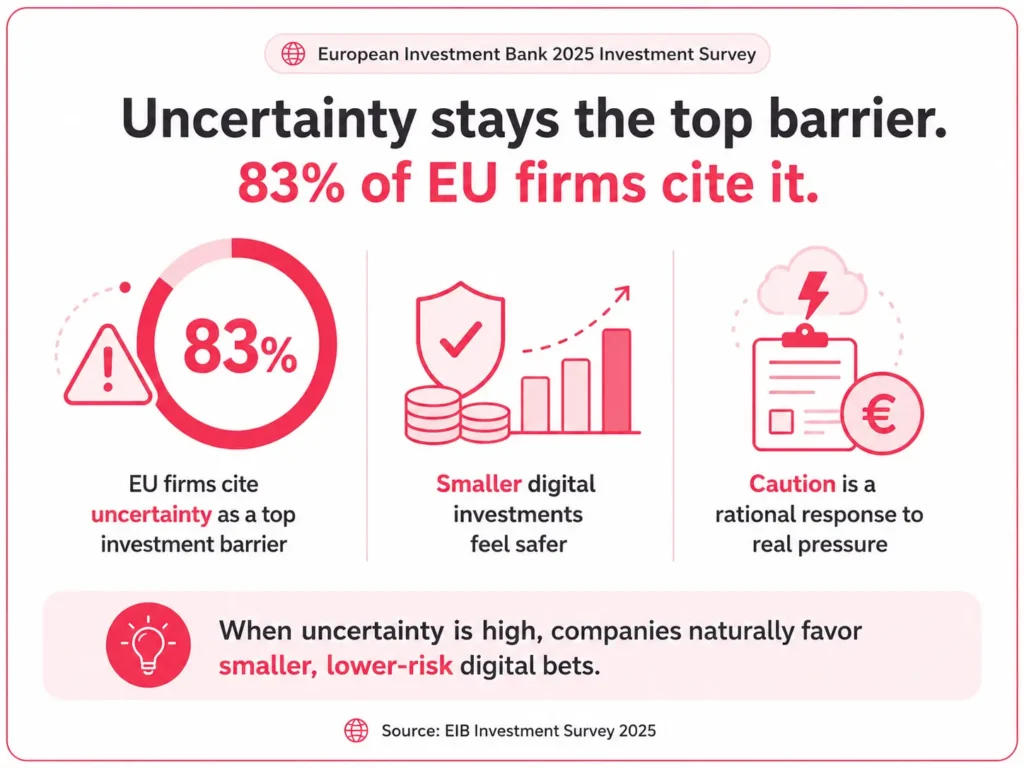
The European Investment Bank’s 2025 Investment Survey found that uncertainty remains the top investment barrier for EU firms, cited by 83% of companies. So the preference for smaller, controlled digital investments is a response to real pressure. And we get that.
But there is a hidden trade-off
Small projects often reduce visible delivery risk while increasing long-term fragmentation.
What we mean by this is that one department gets its tool and another gets a separate workflow. Both teams now solve a local problem. But the organisation as a whole does not become better at improving or scaling digital solutions this way.
Small projects are easier to approve because they ask less of the organisation.
The hidden cost is digital amnesia

Every digital project teaches the organisation something.
- It reveals which processes are unclear
- Which data cannot be trusted
- Which departments define the same metric differently
- Which approvals slow everything down
- Which systems do not speak to each other
- Which users need more support
- Which internal owner was missing from the beginning
Learning is valuable, but in many companies, it never becomes organisational memory. It stays with the vendor or the few people who attended the workshops.
Then the next project starts, and the same discovery happens again. The same data questions and the same unclear ownership pop up, among other things. That same “we did not know this would affect that team” we heard so many times.
This is one of the most expensive forms of waste in digital work. A company can successfully finish ten digital projects and still remain strangely immature if none of the learning becomes part of how the organisation works.
That is digital amnesia and it is more common than most leaders would like to admit.
Tool adoption is not digital capability
Europe is not starting from zero. Most companies now use digital tools in some form. According to Eurostat’s 2025 digitalisation report, 73% of EU SMEs reached at least a basic level of digital intensity in 2024.
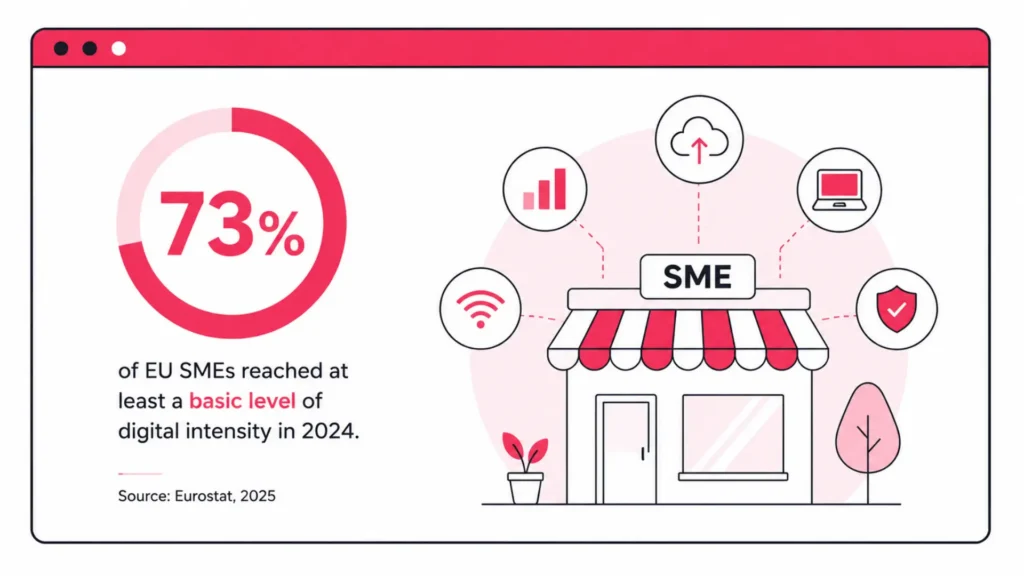
That sounds encouraging. But the same report shows that only 6% of SMEs reached a very high level of digital intensity. Large companies are much further ahead.
This “high level” is about how deeply those tools are used, connected, and turned into better ways of working. Digital maturity is reached when the company becomes better at changing through those systems.
That is especially important now because AI does not reward surface-level digitalisation. They reward organisations that have stronger data, clearer processes, better ownership, and the ability to scale new ways of working.
Otherwise, the AI solution is far from a cost-saver, as it’s promoted to be.
Technology creates value through the system around it and not through itself.
Stop outsourcing the learning
A vendor can build the system. But the organisation still needs to understand why the system works the way it does.
- Which choices were made?
- Which trade-offs were accepted?
- Which risks remain?
- Which data matters most?
If the vendor becomes the only one who understands the logic behind the system, the project has not delivered capability.
What every project should leave behind
A good digital project should solve the problem it was brought to solve. A better digital project should also make the next problem easier to solve.
Not every company can launch a big digital transformation, and we get that. But the good news is that capability can be built practically, project by project.
Therefore, each project should at least leave something reusable behind.
- That may be a cleaner data definition.
- A better integration.
- A reusable API.
- A clearer ownership model.
- Documented business rules.
- A tested governance process.
- Shared reporting standards.
- Better authentication and permissions.
It can also leave a better habit.
For example, the habit of asking who owns the process after launch. The habit of documenting why key decisions were made. The habit of involving users before the final demo. The habit of treating go-live as the start of improvement, not the end of responsibility.
Change the buying question

Most digital project approvals are built around familiar questions: “What are we buying and what does it cost?”
A capability-based buying conversation adds a few more:
- What internal capability will this strengthen?
- Who will own it after launch?
- What knowledge must be transferred?
- What will become reusable?
- Which process will improve?
- Which data standard will improve?
- How will this reduce dependency next time?
- What will we measure after go-live?
These questions change the role of the project. They make it part of a longer digital journey and, as a bonus, they make vendor relationships healthier. The kind of relationship where the client becomes stronger with every project.
Take digital analysis seriously, not just launch
Many companies still fund digital change as a temporary event. Budget is allocated to build the system, and as a result, improvement becomes a future discussion.
A better model treats digital project analysis as the first serious feedback point. Analysis pays for itself by preventing one avoidable mistake. It buys fewer surprises, and more importantly, it buys better decisions before the project has even begun.
That is the capability mindset every company can adopt.
Projects should leave clients stronger
At Net Group, we believe the answer is to stop buying projects that leave the same capability gap untouched.
A serious digital partner should deliver the system but also help clarify ownership, improve processes, strengthen data readiness, document critical decisions, create reusable architecture, and prepare the organisation for continuous improvement.
Companies will always need projects. But projects alone do not create transformation. Transformation starts when those deliverables strengthen the organisation behind them.
A digital project should deliver what was promised, certainly. But it should also leave something behind. Otherwise, the company is buying digital outputs and hoping they add up to transformation.
Similar insights

The integration debt you’re probably not budgeting for
15/09/2026
Your board can now be held liable for cyber risk (NIS2)
08/09/2026
The dangerous appeal of vibe coding: Know when, and when not
18/08/2026
Data Trust Score: After data readiness, you need trust
11/08/2026
Why digital transformation fails in the middle (management)
20/07/2026
Every digital system needs this simple operating model
14/07/2026
The hidden cost of “small changes” in digital projects
09/06/2026
Minimum Viable Data: The standard all digital systems need
19/05/2026
AI is a great cost-saver – Until it’s not!
13/05/2026
Let the success
journey begin
Our goal is to help take your organization to new heights of success through innovative digital solutions. Let us work together to turn your dreams into reality.

